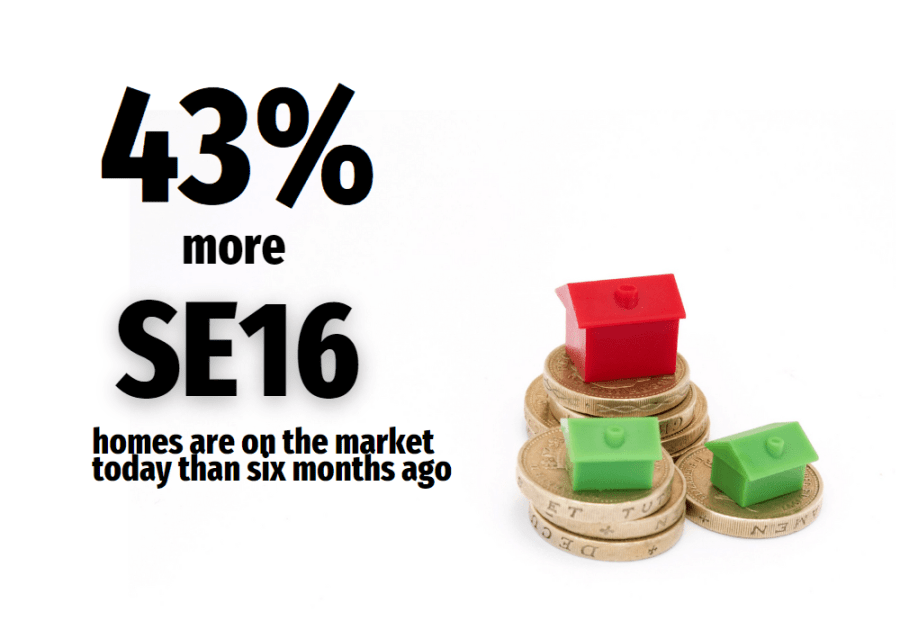
More SE16 homes are now coming up for sale.
This is excellent news for SE16 homebuyers and SE16 landlords because as properties are no longer flying off the shelf as they did last year, the number of properties available to buy is beginning to return to long-term averages.
This means there is greater choice for SE16 buyers and this will reduce the pressure on SE16 house prices and return us to a more normal SE16 housing market for buyers (and sellers).
The average UK estate agency now has 25 homes for sale, the highest level of properties on the market since December 2021
(when it was 21 homes for sale).
However, properties per estate agency brand is not the best judge of the property market.
Let’s look at the actual SE16 stats, which tell a slightly different story.
- SE16 Detached Homes – early spring, 63 available and today, 83 available – a rise of 32%
- SE16 Semi-Detached Homes – early spring, 16 available and today, 40 available – a rise of 150%
- SE16 Terraced/Town Houses – early spring, 7 available and today, 30 available – a rise of 329%
- SE16 Apartments – early spring, 38 available and today, 34 available – a fall of 11%
Overall, an increase of 43% – year on year.
This growth in properties for sale has been seen across all areas of the British Isles. This is important because when there is a more significant availability of homes for sale, this diminishes the increasing pressure on house prices.
So how does a low number of properties for sale make such a huge difference?
Coming into the early spring of 2022, the levels of properties for sale were low (as seen from the low December 2021 stats above). It was ‘Hobson’s choice’ for buyers, so they had to pay top dollar to secure their SE16 home.
The value of SE16 properties that had their sale agreed upon in the early spring of 2022 (and completed their sale in September 2022) is 12.1% higher than those SE16 properties that had a sale agreed upon in the spring of 2021.
The number of properties estate agents have to offer buyers is increasing; this will boost the choice for SE16 buyers, meaning we will move into a more balanced SE16 housing market.
Nevertheless, it’s vital that SE16 sellers place their properties, when they go onto the market, in line with what SE16 homebuyers are prepared to pay, given the current hit to their buying power initiated by higher interest rates.
SE16 house prices are not expected to crash in 2023,
yet they will be lower than in 2022.
If you are buying and selling in the same property market, it doesn’t matter what happens to property prices.
Also, some might say waiting for SE16 house prices to drop will enable them to grab a bargain.
Well, sorry to ‘rain on your parade’, but you should read my recent article that discusses what would happen if SE16 first-time buyers waited for SE16 house prices to drop. If they waited, because interest rates are rising, the extra mortgage payments would cost them a lot more than the savings made on the purchase price. (Send me a message if you want a copy of it).
What has an effect on the value of your SE16 home is the number of properties for sale at any one time compared to the number of buyers. When there is an over-supply of homes for sale, prices go down, and with reduced demand, house prices will go down. So how do the stock levels of properties for sale compare to the past?
If you recall at the start of the article, I stated the average UK estate agency had 25 properties on their books now. In 2018/9, that average was 36 properties for sale (and for added comparison, the long-term average, since records began in 2016, is 49 homes for sale).
As you can see, whilst stock levels have grown, we are a long way off the long-term average.
A great way to determine what will happen to the property market is by measuring that stock level (i.e. the number of properties for sale). Check once a month and see how many properties are for sale. Let me break that down for SE16 specifically and how you can judge the market from your sofa.
There are 378 properties and plots for sale in SE16 now. To give context, the long-term 16-year average is 389 properties and plots for sale, yet in the credit crunch of 2008, it reached 618 properties and plots for sale at one point.
I envisage some component of scarcity to persist in the SE16 property market, meaning whilst the house prices that were being achieved in the spring of 2022 won’t be replicated in 2023, it also won’t fall dramatically next year.
The incentives and impetuses to move home have changed in the last six months and will continue to do so into 2023.
As I have written before, there are a larger number of mature homeowners in their 60s and 70s downsizing to help with heating bills, whilst the desire for more space means younger families will continue to look for new homes to live in, in 2023.
If younger 20-somethings can access the Bank of Mum and Dad for mortgage deposits, they will also carry on buying. This is especially true because double-digit rental inflation makes renting quite expensive compared to buying (even with the increased interest rates).
These are my thoughts on the SE16 property market this week. Do put in the comments (or send me a message) your thoughts on the matter discussed and any other property-related topic you want some advice and opinion on.
Thank you in advance …


 The SE16 Property Blog