
If you’re a homeowner in SE16 thinking about selling, brace yourself for a bit of uncomfortable truth.
There is a growing gap in our area between what SE16 home sellers want and what buyers are actually willing to pay. And the evidence for this is laid out, month after month, in cold, hard numbers.
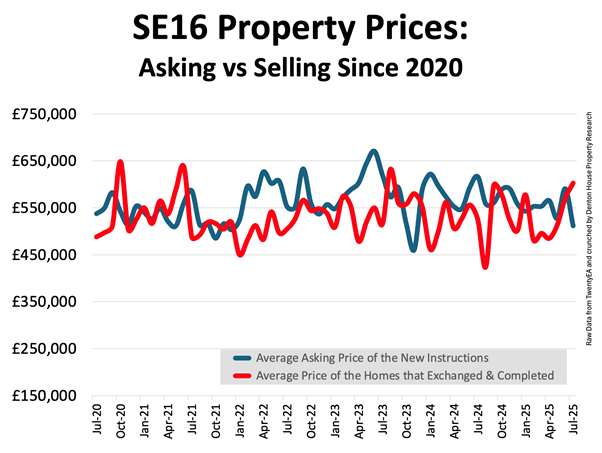
Since the summer of 2020, we’ve been tracking two key numbers: the average asking price of homes coming to market in SE16, and the average sale price of homes that exchanged and completed. The results are striking and eye-opening.
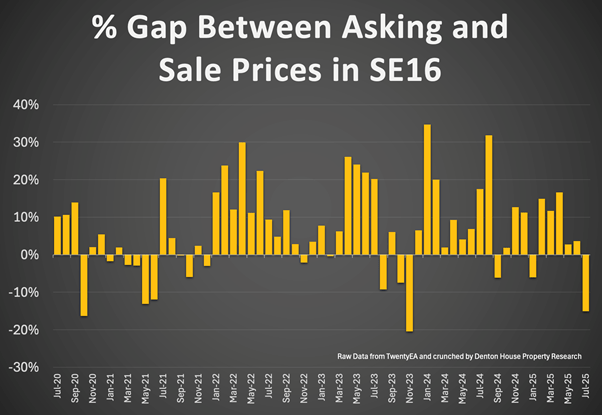
In 2025 so far, the average asking price of the homes coming onto the market in SE16 has been £549,200. But the average price of an SE16 home that’s actually sold and completed is £532,200. That’s a 3.2% difference.
And no, this isn’t about a property crash or SE16 sellers taking a 3% or more hit on their asking prices. This is about what sells versus what sits on the market.
It’s Not That SE16 House Prices Are Falling. It’s That High-Priced SE16 Homes Don’t Sell as Well
Let’s be very clear. This 3.2% gap doesn’t mean house prices have dropped by 3.2%. It simply shows that SE16 homes at the higher end of the market are much less likely to sell. They get listed, they linger, and they often withdraw unsold. Meanwhile, lower-priced SE16 homes tend to fly off the shelf.
It’s a classic case of saleability versus ambition.
In 2020, the gap between average asking and average sale price in SE16 was 3.4% (£546,700 asking vs £528,900 selling).
By 2021, it was -1.5%. Rose to 11.8% in 2022, was 6.0% in 2023, 11.2% in 2024, and now we’re at 3.2% in 2025.
So, what’s going on?
Higher Price Brackets in SE16 Have Lower Odds of Selling
It’s a simple truth: the higher up the price range you go, the harder it is to get a deal done.
That doesn’t mean the more expensive SE16 homes won’t sell. But it does mean your pricing and presentation must be spot on for it to sell.
Wishful thinking won’t cut it.
The average asking price of property that has come on the market in SE16 in the last five years has been £551,400.
- For all the SE16 homes that have come onto the market below £551,400 in the last 5 years, they have had a 37.2% chance of selling and homeowners moving.
- For all the SE16 homes that have come onto the market above £551,400 in the last 5 years, they have had a 35.7% chance of selling and homeowners moving.
Realistic Pricing Matters
Here’s another stat SE16 home sellers need to understand.
Homes that agree a sale within 25 days of coming onto the market have a 94% chance of subsequently exchanging contracts and completing (i.e. the homeowner moves). Yet, for homes that sit for 100 days or more before a sale is agreed, the odds of the homeowner moving drop to just 56%.
In other words, if you get the price right from day one, you are far more likely to secure a solid buyer and sail through to completion. But if your home languishes on the portals for months, you are not only likely to have to reduce, if you do indeed manage to agree a sale on it, your odds are only slightly better than a flip of a coin.
What This Means for SE16 Homeowners
If you’re thinking of putting your home on the market this year, here’s the uncomfortable but helpful advice:
- Don’t just look at what homes are being listed for. Look at what’s selling — and selling within a month or two.
- Be honest about your timeframe. If you want to move soon, pricing realistically from day one will give you a better shot.
- Higher-value homes must work harder. Presentation, photography, pricing, and agent skill all matter more than ever when your SE16 home sits in the upper price bands.
The Bottom Line for SE16 Homeowners
Many homes listed in SE16 this year won’t sell.
Not because they are bad homes. Not because the market is broken. But because many sellers and yes, some estate agents, are still pricing for the market they wish they had, rather than the market we do have.
If your SE16 home is priced at the top of its range, you must demand an agent who can justify every pound, back it up with real buyer insights, and be honest with you from the start.
Otherwise, you risk becoming part of the SE16 homeowners that don’t sell, as opposed to the SE16 homeowners that move to the next chapter of their life.


 The SE16 Property Blog